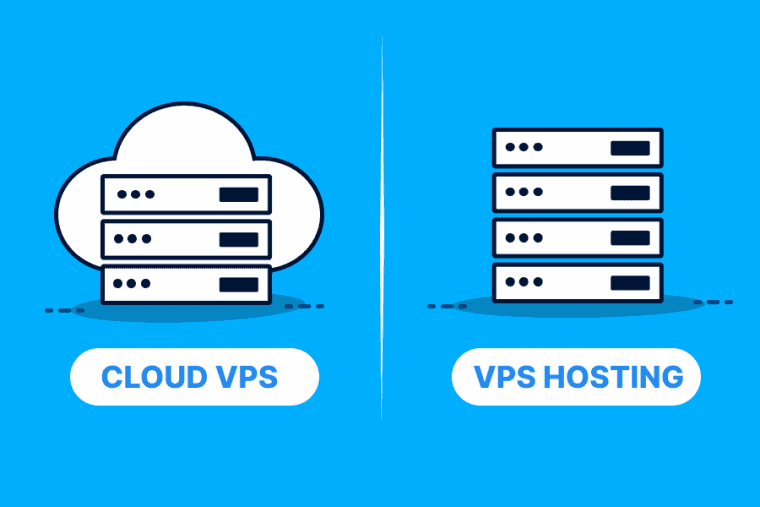


It’s important to pick the right hosting solution these days, whether you’re making your first website or growing your business online. Cloud VPS and VPS Hosting are two terms you will hear a lot. They may sound the same, but their architecture, performance, price, and reliability are all very different.
This guide will help you make a smart choice in 2026 by clearly and simply explaining the difference between Cloud VPS and VPS Hosting.
What Is VPS Hosting?
VPS Hosting (Virtual Private Server Hosting) gives you a virtual machine on a single physical server. Each VPS instance runs independently — you have guaranteed resources (like CPU, RAM, disk).
Traditionally, VPS Hosting has been used as a cost-effective alternative to dedicated servers. It’s more powerful than shared hosting but not as flexible or scalable as cloud-based solutions.
What Is Cloud VPS?
Cloud VPS goes a step further than virtualization by running your VPS on a group of cloud servers instead of just one physical machine. Multiple servers work together to share resources.
This design makes it easier to scale, keeps the system up longer, and gives you more options. If one node goes down, your VPS can switch to another without any downtime. This is a huge benefit for reliability.
Cloud VPS vs VPS Hosting – Comparison Table
| Feature | Cloud VPS | VPS Hosting |
|---|---|---|
| Architecture | Distributed across multiple cloud servers | Based on a single physical server |
| Scalability | High — instant scaling possible | Limited — manual resource upgrades required |
| Performance | Better under load due to cloud resources | Good, but limited by single server |
| Uptime | Higher (redundancy built-in) | Lower (no failover if hardware fails) |
| Pricing Model | Pay-as-you-go / flexible | Fixed monthly/yearly plans |
| Security | Strong isolation plus cloud security tools | Strong isolation, depends on provider |
| Resource Allocation | Dynamic | Static |
| Best For | Growing websites, apps, unpredictable traffic | Small to medium sites with fixed needs |
Performance & Uptime
Cloud VPS Performance
Cloud VPS uses more than one machine in the cloud. This means:
- Faster load times when there is a lot of traffic, because the system can allocate resources on the fly.
- Better throughput for apps that use a lot of CPU and memory.
- Resilience against hardware failure: even if one physical server goes down, the cloud cluster will still serve your site.
Many providers now promise that their services will be up 99.99% of the time or more, thanks to built-in redundancy. This is why Cloud VPS is great for businesses that can’t afford to lose money when their servers go down.
VPS Hosting Performance
Traditional VPS Hosting still offers:
- Dedicated virtual resources, like guaranteed CPU and RAM.
- Dependable performance for tasks that can be predicted.
But since it’s linked to one physical machine:
- If the node gets too busy, performance can drop.
- If hardware breaks and you can’t do live migration, uptime may go down.
Which Is Faster?
In most real-world scenarios, Cloud VPS outperforms traditional VPS Hosting, especially under variable demand. This is because cloud resources scale automatically to meet sudden spikes in traffic.
Pricing Breakdown
Cost is often a major deciding factor — but price structures for Cloud VPS and VPS Hosting are very different.
Cloud VPS Pricing
Cloud VPS usually offers flexible, usage-based pricing, which means you pay for:
- CPU usage (hours)
- Bandwidth consumed
- Storage space used
- Optional add-ons (backup, managed services, security)
Pros
- Pay only for what you use
- Ideal for unpredictable traffic
- Easy to scale up/down
Cons
- Costs can increase if usage spikes
- Harder to predict monthly bills unless capped
VPS Hosting Pricing
VPS Hosting typically offers fixed monthly or yearly pricing based on:
- Package tier (Starter, Standard, Pro, etc.)
- Allocated CPU, RAM, Disk
Pros
- Predictable monthly cost
- Simple billing
Cons
- You may pay for unused resources
- Upgrading often requires downtime
Which Is Better for Beginners?
Beginners often choose based on simplicity and support:
VPS Hosting – Good for Beginners
- Simple pricing
- Easy setup with control panels (cPanel, Plesk)
- Good for basic websites and blogs
If you’re just starting out and traffic is predictable, VPS Hosting can offer the easiest entry point.
Cloud VPS – Also Beginner-Friendly
With managed control panels and automated features, many Cloud VPS platforms are now beginner-friendly too. Providers often include:
- One-click app installs
- Auto-scaling
- Performance monitoring dashboards
Conclusion: If you want to learn server administration step by step and keep costs predictable, VPS Hosting is great. But if you want more flexibility with room to grow, Cloud VPS is often worth the slight learning curve.
Which Is Better for Businesses?
For businesses with growth ambitions, performance and reliability matter most.
Cloud VPS – Best for Business Growth
- Scales with demand — no reboot or migration needed for upgrades
- Better uptime — critical for e-commerce & SaaS
- Flexible resource allocation — accommodates seasonal traffic spikes
Cloud VPS is especially valuable if your business:
- Runs dynamic web applications
- Has global user traffic
- Cannot afford downtime
VPS Hosting – Still Useful
For fixed workloads and predictable traffic, traditional VPS Hosting remains a cost-effective option, especially for:
- Portfolio sites
- Small company pages
- Internal tools with light usage
Recommended Solution: Cyberin Cloud VPS
If you’re considering Cloud VPS in 2026, Cyberin Cloud VPS deserves a close look.
Why choose Cyberin Cloud VPS?
- Elastic scaling: Automatically handles sudden traffic bursts without manual intervention.
- High uptime: Built with redundancy so your systems stay online even if hardware fails.
- Affordable pricing: Competitive plans for startups and enterprises alike.
- Performance optimized: Fast SSD storage and powerful CPU options.
- User-friendly dashboard: Great for beginners and pros alike.
- Enhanced security: Built-in firewalls, backups, and threat monitoring.
Whether you’re launching a business site, SaaS platform, or high-traffic portal, Cyberin Cloud VPS is an excellent hosting partner for 2026.
FAQs: Cloud VPS vs VPS Hosting
1. Is Cloud VPS better than VPS Hosting?
In most cases, yes — especially for performance, scalability, and uptime. Traditional VPS Hosting is still useful for smaller, predictable workloads.
2. Which is cheaper — Cloud VPS or VPS Hosting?
It depends. VPS Hosting usually has fixed plans that can be cheaper for smaller sites. Cloud VPS is flexible, but usage-based pricing can fluctuate.
3. Is Cloud VPS harder to manage?
Not necessarily. Many Cloud VPS providers now offer intuitive dashboards and managed services, making them accessible even for beginners.
4. Can I migrate from VPS Hosting to Cloud VPS?
Yes. Most hosting providers support migrations or offer tools to ease the switch.
5. Which should I choose for e-commerce?
Cloud VPS is typically the better choice due to its scalability and reliability — especially during peak shopping seasons.
Conclusion
To choose the right infrastructure in 2026, you need to know the difference between Cloud VPS and VPS Hosting. Cloud VPS wins if uptime, performance, and scalability are the most important things. If you want things to be simple and predictable, traditional VPS Hosting is still useful.
Cyberin Cloud VPS is a cloud hosting service that is strong, reliable, and flexible. It offers the best balance of performance and cost for businesses and big projects.