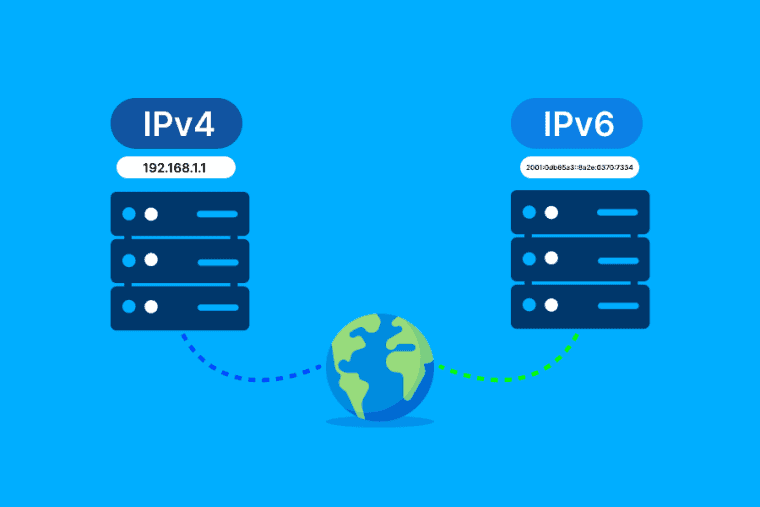


Websites, servers, computers and other devices on the internet are all connected together using IP addresses. IPv4 has long been the de facto scheme for addressing. But the explosion of websites, smartphones, cloud services and connected devices has led to a serious shortage of IPv4 addresses.
That’s what IPv6 solves. IPv6 offers a vastly larger address space and a number of improvements to today’s networks. Knowing the difference between IPv4 and IPv6 will help you to make better decisions regarding website hosting, DNS, security and future scalability.
What Is IPv4?
IPv4 ( or Internet Protocol version 4 ) is the most widely used IP address scheme . It has a 32-bit address, which means it can have approx. 4.3 billion different addresses.
An IPv4 address is displayed as four numbers separated by periods.
Example:
192.168.1.10
Every number has a minimum value of 0 and a maximum value of 255. With a limited supply of IPv4 addresses, organizations are increasingly turning to technologies like NAT to allow multiple devices to share a single public IP address.
What Is IPv6?
Internet Protocol version 6 ( IPv6 ) was developed to overcome the limitations of IPv4 . It uses 128 bit addresses and that is a very large number of possible addresses .
An IPv6 address consists of hexadecimal characters separated by colons .
Example:
2001:0db8:85a3:0000:0000:8a2e:0370:7334
The larger address space makes IPv6 appropriate for continued internet growth, cloud computing, mobile networks and connected devices.
IPv4 vs IPv6: Key Differences
| Feature | IPv4 | IPv6 |
|---|---|---|
| Address size | 32-bit | 128-bit |
| Example | 192.168.1.10 | 2001:db8::1 |
| Address availability | Limited | Extremely large |
| Address format | Decimal | Hexadecimal |
| NAT | Commonly used | Generally unnecessary |
| Configuration | Manual or DHCP | Supports automatic configuration |
| Broadcast | Supported | Replaced by multicast mechanisms |
| Long-term scalability | Limited | Excellent |
IPv4 vs IPv6: Security Differences
IPv6 was developed for the needs of today’s networking. IPv6 specifications have native support for IPsec, which provide authentication and encryption mechanisms.
But IPv6 does not automatically make a website secure. Website owners still need HTTPS, firewalls, secure applications, strong authentication and regular updates.
Therefore, when comparing IPv4 vs IPv6, security should not be the only reason to enable IPv6.
Performance and Routing Efficiency
In some environments, IPv6 can improve network efficiency. Its larger address space reduces the need for widespread NAT, and the addressing scheme can allow more efficient routing.
The real speed of IPv4 and IPv6 depends on the network, hosting provider, ISP, routing path and configuration. So IPv6 is not necessarily faster in every case.
For websites the IPv6 address is not as important as having your server and DNS configured correctly.
Why Should Your Website Support Both?
Supporting IPv4 and IPv6 offers you more options to connect visitors.
Some users may be behind IPv4-only networks, some may be behind IPv6-enabled mobile or broadband networks. If your site supports both, visitors can connect using whatever protocol is available to them.
This is commonly referred to as dual-stack networking.
For instance, your domain might have:
A record → 203.0.113.10
and:
AAAA record → 2001:db8::10
The A record points to an IPv4 address. The AAAA record points to an IPv6 address.
IPv6 and SEO
There is no direct SEO ranking boost from enabling IPv6. Search engines are most interested in things like useful content, accessibility of the website, performance, mobile usability and technical reliability.
But IPv6 can offer better access for clients on the IPv6 enabled networks. Properly configured dual-stack websites can also help keep your infrastructure compatible with the modern networks.
So, ipv6 should be seen as part of good technical infrastructure, not a stand alone SEO strategy.
How Hosting Providers Implement IPv6
“IPv6 has to be configured on many levels by a hosting provider. This can include server network interfaces, routing, firewalls, DNS and customer hosting accounts.
To make a website work correctly over IPv6, the hosting environment needs to have a valid IPv6 address and the correct network configuration. The domain can then direct visitors to the IPv6-enabled server with a AAAA DNS record.
Your hosting provider should also be ensuring that security rules and monitoring are covering IPv6 traffic too.
IPv6 Migration Best Practices
The move from IPv4 to IPv6 doesn’t have to be all or nothing. Generally it is easier to approach it bit by bit.
First check with your hosting provider and network if they support IPv6. Then take the IPv6 Address and configure the firewall on the server.
Then add the matching AAAA record to your DNS zone: Test your site from at least a few networks that support IPv6 before making anything permanent.
Keep IPv4 during transition. That means visitors on IPv4-only networks can still reach your website.
Frequently Asked Questions
Is IPv6 better than IPv4?
IPv6 has a much larger address space and was designed to enable the long term growth of the Internet. But IPv4 remains very much in play. So it’s easy to root for both.
Does IPv6 make my website faster?
Not really. Performance depends on routing, network quality, server configuration and the visitor’s ISP. IPv6 – right networks understand
Does IPv6 improve SEO?
Google does not use IPv6 as a direct ranking signal. Best is. Improved compatibility and coverage on the latest networks.
Should my website support IPv4 and IPv6?
Yes. By supporting both, your website will be compatible with a larger number of networks and your infrastructure will be ready for continued IPv6 adoption.
Conclusion
As more and more devices connect to the Internet, the debate over IPv4 vs IPv6 becomes increasingly important. IPv4 remains important because of its ubiquity, while IPv6 provides the address space needed for the future.
In practice most websites support both protocols. Dual-stack hosting, correct A and AAAA DNS records, correct firewall rules, and full testing allow organizations to remain IPv4-compatible and prepare for an internet that is increasingly IPv6-connected.