

Selecting web hosting in India is not merely about the cheapest price per month. For a small business, your hosting can impact site speed, reliability, security, support and how easily your site can scale.
Established providers like Hostinger, Bluehost, GoDaddy, HostGator and others offer a combination of pricing, infrastructure, resources and support. Or, smaller, India-centric providers can go down a different path.
In this guide we will examine what Indian startups and small businesses should be looking for in web hosting, what type of hosting may be suitable for different websites and how to compare providers before deciding. It also considers where Cyberin falls in that comparison without presuming one provider is right for every business.
What Indian Startups and Small Businesses Actually Need
Before you start shopping for web hosting solutions it is wise to think about the factors which will affect your website in the long run:
- fast loading speed Your server location, the amount of hosting resources, caching, network routing and a CDN will all affect how fast your pages load for your visitors.
- Fair and Transparent Pricing: Watch out for not just the introductory price but the renewal price as well and if there are any essential services or features that you will have to pay extra for.
- Uptime reliability: Your customers can’t get to your website if your website is down a lot. Check the provider’s outage policy and the uptime guaranties.
- Backups Security: Business websites require SSL, account security, malware protection, automatic backups and an easy restoration process.
- Ease of management: Hosting with tools such as cPanel, automatic updates, backups and one click application installers can be easier to manage without dedicated technical staff.
- Responsive support: Know when you can get support, what channels are available and whether the support team can help you with technical hosting issues.
- Room to grow The hosting plan that works for a new website may not be good enough as traffic, content or applications increase. Learn how easy it is to increase resources or migrate to a more robust hosting environment.
Which Type of Web Hosting Does a Small Business Need?
The right type of hosting will depend on your website’s traffic, software, technical requirements and expected growth. A new local-business website doesn’t require the same infrastructure as a high-traffic online store.
| Hosting type | Generally suitable for |
|---|---|
| Shared hosting | New websites, portfolios, blogs, and small business websites with moderate traffic |
| WordPress hosting | Businesses running WordPress that want hosting and performance features tailored to the platform |
| VPS hosting | Growing websites and applications that need more dedicated resources or greater control |
| Cloud hosting | Websites and applications that need flexible resources and an easier path to scaling |
Many small businesses can get by with shared or managed WordPress hosting when they’re just starting out. A VPS or cloud environment may offer more flexibility as traffic and resource needs grow.
The important point is not to choose the most powerful hosting plans available. Instead, choose an environment that provides enough resources for your current requirements while giving you a practical upgrade path as the business grows.
What to Check Before Choosing a Hosting Provider
Once you know what kind of hosting you need, compare providers against the same criteria, not just their advertised monthly price.
Server Location and Network Performance
If most of your visitors are in India, check the location of the hosting infrastructure and the provider’s network connectivity to your audience. Server location can affect latency, but it’s only one factor in website performance. Caching, CDN setup, server load and website optimization do matter too.
Resources and Performance
Forget storage and bandwidth. The hosting type, CPU resources, RAM, I/O performance, concurrent processes, PHP workers, and other resource limits can all have an impact on how a website performs under load.
Security
If the plan includes security features, review what they are. For a business website, SSL/TLS, malware protection, firewalls, account isolation, secure authentication, and software updates can all be important.
Backups and Restoration
Don’t think that a plan that has “backups” will give you all that you need. Find out how often they backup, how long they keep them, where they keep them and whether they back up restoring a website or if they charge for it separately.
Pricing and Renewals
Introductory hosting prices can be very different from renewal prices. Before you buy, compare the first term price, renewal rate, billing period, domain costs, taxes and optional features you might need later.
Customer Support
Check out the availability and channels of support offered such as live chat, tickets, or phone support. For a small business without dedicated technical staff, access to useful technical assistance may be more important than a small difference in monthly price.
Scalability
Consider what happens when your website grows. See if you can upgrade resources, migrate to a VPS or cloud plan, or otherwise scale the hosting environment without having to rebuild the website from scratch.
Comparing hosting plans becomes easier when you use the same criteria for each provider.
A Few Well-Known Options, Fairly Considered
There are several established hosting companies that focus on Indian customers but they differ on the infrastructure, pricing, support and the kind of websites they cater to. Rather than trying to find a provider that is “best” across the board, compare each one to your own needs.
Hostinger has competitive intro pricing and a wide international footprint. Compare its plans and check out renewal pricing, included resources, server locations, and what features are offered at each tier. Its international infrastructure may also be a benefit for businesses that serve visitors from multiple countries.
Bluehost is a popular hosting provider and is closely related to WordPress. Businesses looking to compare plans should look at the specific hosting environment, the resources available, the pricing after the intro period, and the support options that come with the plan they choose.
GoDaddy offers domains, hosting, and other website services, so it’s a familiar choice for businesses wanting a few services from one provider. Look at the base plan and see if there are any optional services or add-ons and see what the renewal costs are in terms of hosting.
HostGator have been in the shared hosting and related services business for a long time. Businesses looking at this should look at resource limits, backup and security features, support and the upgrade path as website requirements grow.
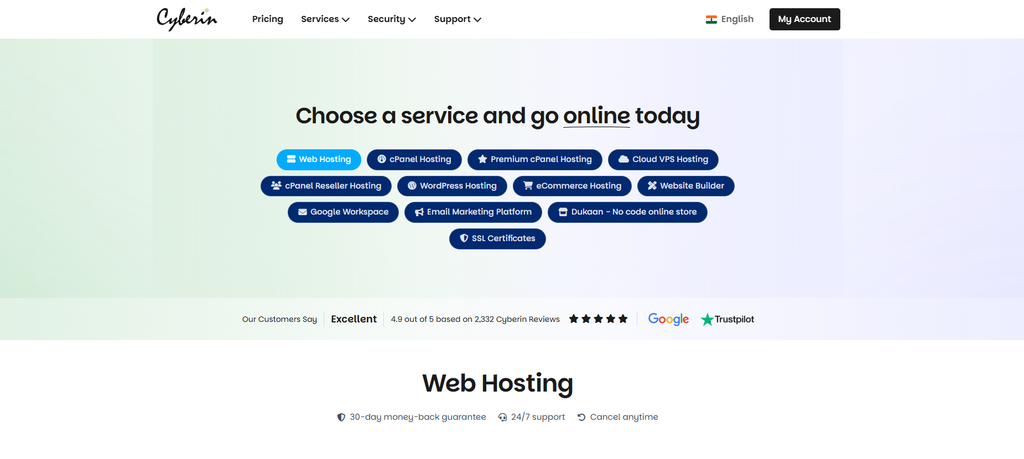
For businesses looking at hosting that is focused on India, Cyberin is another option to consider. You can evaluate its plans using the same factors discussed above: infrastructure location, resources, pricing, management tools, backup, security, support and scalability.
What’s important is that these providers meet somewhat different needs. A business serving only an Indian audience might have different needs than one serving customers in multiple countries, so the same hosting plan might not be the right fit for every website.
How Cyberin Compares With Other Hosting Options
Cyberin is a hosting service provider for the customers in India and offers plans that can be compared with other providers on the same criteria described above.
The hosting plans that Cyberin has published are:
- Hosting infrastructure for customers with Indian audiences
- Published plan pricing and resource details
- Managed Hosting Solutions cPanel
- Features: SSL, backups, depending on the plan you choose
These features can be useful for small businesses that want a managed hosting environment and want to compare options from India against larger international providers.
But the right choice still depends on the website. For example, a business with customers in many countries might assign a higher priority to international infrastructure than a small India-focused site, which might focus on local performance, support availability, pricing and ease of management.
Don’t take for granted that one provider is the best choice. Compare the actual plan you are considering against your expected traffic, technical requirements, budget and growth plans.
What This Actually Means for You
If your audience is international, or you’re expecting enterprise-scale infrastructure, the established global names above genuinely have the edge — scale, data center breadth, a longer track record.
If your audience is mostly India-based and you want simpler, more predictable pricing, Cyberin’s India-first approach may suit you well. Worth being upfront, though: we’re smaller and newer to this scale than the names above, and that’s a fair thing to weigh honestly before deciding.
Which Businesses May Need India-Focused Hosting?
If an India-centric hosting alternative deserves a comparison:
- Most of your website visitors are from India
- You have a small business website, blog, portfolio or a fledgling online store.
- You are looking for a managed hosting environment rather than taking care of server administration yourself
- Having local support is important for your business
- You want to compare hosting plans in terms of Indian pricing and infrastructure.
These requirements do not necessarily make an India-centric provider the right choice. Your final decision should still consider your traffic, application requirements, budget, technical experience and expected growth.
Frequently Asked Questions
1) What should a small business look for in web hosting in India?
A small business needs to consider performance, server location, uptime, security, backups, customer support, pricing, resource limits and how well the provider can scale with the growth of the website.
2) Which type of hosting is suitable for a small business website?
The right type of hosting is dictated by your technical and traffic needs. Shared hosting is a good option for a new or small website. As needs grow, WordPress hosting, VPS hosting or cloud hosting may be a better fit.
3) Does server location matter for websites targeting Indian visitors?
Where the server is located can impact network latency, but it’s not the only thing that impacts a website’s speed. Performance also depends on CDN configuration, caching, server resources, network routing and website optimization.
4) How much does web hosting cost for a small business in India?
The hosting fee varies with the provider, hosting type, resources and billing period. Compare the introductory price to the renewal price and be sure to note if domains, backups, security features, taxes or other services cost extra.
5) What should I compare before choosing a web hosting provider?
Compare the provider’s infrastructure, performance resources, uptime commitments, security, backup policy, support, pricing and renewal terms, control panel and upgrade options. This makes it easier to choose as providers are matched on the same criteria.
Conclusion
Hostinger, Bluehost, GoDaddy, and HostGator are all established, legitimate global hosting brands — this was never about any of them being a poor choice. For Indian startups and small businesses that specifically prioritize local server performance and simpler, bundled pricing, Cyberin is a reasonable option worth considering alongside them.
Compare two or three options against your specific needs — audience location, technical comfort, budget. Don’t assume any single provider, including us, is automatically the best fit for you. If you want a broader look at the field, here’s a wider comparison of hosting providers in India.