

The speed of a website isn’t just a matter of your internet connection. Your hosting server and storage technology are also big factors.
Traditional SSDs are already far faster than older hard disk drives. But NVMe SSD Hosting can take your storage performance to the next level.
So, how is SSD different from NVMe SSD? Does NVMe actually speed up a website? And which one to choose?
Let’s try to compare the two storage technologies in simple terms.
What Is SSD Hosting?
SSD – Solid state disk. Unlike traditional hard drives, SSDs have no moving parts or spinning disks.
Instead they keep their data in flash memory. This allows an SSD to read and write data much faster than a traditional hard drive.
SSD hosting can load files faster, respond faster to database requests on sites . It is a popular choice for blogs, business sites, online stores and other sites that demand strong storage performance.
But not all SSD storage is the same.
What Is NVMe SSD Hosting?
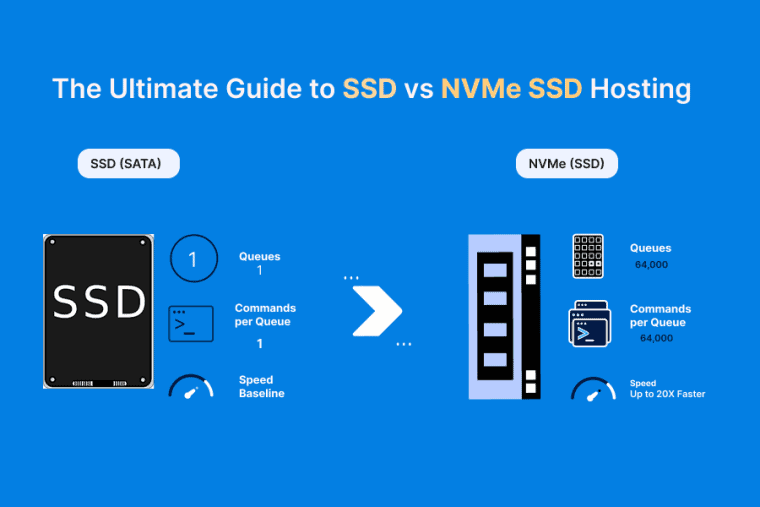
NVMe (Non-Volatile Memory Express) 5. This is a storage protocol for modern flash storage.
NVMe SSDs are most commonly connected via the PCIe interface, while many traditional SSDs use the older SATA interface.
This makes it easier for the server to communicate with the storage device.
That allows NVMe drives to provide higher throughput, lower latency and better performance for many storage operations.
In simple terms, both use flash storage technology. NVMe is a faster way for the server to communicate with storage .
SSD vs NVMe SSD: What Is the Difference?
The main difference is how they connect and communicate.
SATA SSDs of the traditional variety used an older storage interface. NVMe is designed for modern flash storage and uses PCIe.
That difference can affect a lot of areas of server performance.
Speed NVMe drives can provide considerably higher data transfer speeds than SATA SSDs.
Latency : NVMe generally has lower latency, allowing faster processing of storage requests .
I/O Operations: NVMe can support a large number of concurrent I/O operations efficiently.
Scalability: NVMe is more suited to modern servers that must handle heavy workloads.
That doesn’t mean every site is going to see a huge difference. The actual improvement depends on the server hardware, website software, database activity, caching and traffic.
How Does NVMe Improve Hosting Performance?
A web site is always reading and writing data.
For example, let’s say someone visits a website that is built on WordPress. The server may need access to PHP files, databases, images, plugins and other resources.
Performing such operations in a faster storage can reduce the time to do so.
This can be especially helpful if your site makes a lot of database requests or if you are dealing with lots of visitors at the same time.
An online shop, for instance. It could manage product databases, customer accounts, orders, images and payment-related processes all at the same time.
This is where NVMe storage can help the server handle these storage operations better.”
SSD vs NVMe SSD: Cost and Reliability
This is because NVMe SSDs are faster and a newer technology, so they tend to be a little more expensive than your average SATA SSDs.
But the price difference depends on the hosting provider and the server setup in general.
And then the question of dependability. SSDs and NVMe SSDs have no moving mechanical parts, so many of the failure points that exist in traditional HDDs are removed.
But no storage device is invincible.
So, regular backups are always important regardless of the storage technology your hosting provider uses.
Which Websites Need NVMe Hosting?
Not every site needs the fastest storage.
If it’s a small personal blog with less visitors, normal SSD storage might be fine.
More helpful for:
- Business websites with regular traffic and dynamic content.
- eCommerce stores with product databases and customer activity.
- WordPress websites using multiple plugins and database queries.
- High-traffic websites handling many requests at the same time.
- Web applications that frequently read and write large amounts of data.
If your website is growing, faster storage can also give your hosting environment more room to handle heavier workloads.
What About Benchmarks?
Storage benchmarks can show SATA SSDs vs NVMe SSDs having a huge difference.
NVMe drives , for example , can read and write sequentially several times faster than SATA SSDs . NVMe can also deliver much higher IOPS in the right workload.
But you shouldn’t pick a hosting plan solely from benchmark numbers.
The actual performance of a website also depends on CPU power, RAM, network speed, web server software, caching, database configuration and server load.
A fast NVMe drive will not fix a badly optimized website on its own.
How to Choose the Right Hosting Plan
Compare Hosting Plans Don’t Just Compare Storage Speed
Look at the storage, CPU resources, RAM, bandwidth, backups, security features, uptime and support.
A common SSD hosting solution should be enough for a simple blog.
For those operating a business or an online store, the additional storage performance of NVMe SSD hosting can assist you in handling more substantial workloads.
If your website already has a lot of traffic or you do a lot of database operations, NVMe is worth considering.
Frequently Asked Questions
Is NVMe faster than SSD?
NVMe SSDs are generally faster than SATA SSDs because they use the PCIe interface and a protocol designed for modern flash storage.
Does NVMe make my website load instantly?
No. Storage is only one part of website performance. Caching, images, code, server resources, and network speed also matter.
Is NVMe worth it for WordPress?
It can be useful for WordPress websites with high traffic, large databases, or many dynamic requests. Small websites may not notice a major difference.
Is NVMe more reliable than SSD?
Both can be reliable. Good backups are still necessary because any storage device can fail.
Conclusion
SSD hosting is a massive improvement over traditional hard drives. NVMe builds on the technology to permit faster communication between server and storage.
For simple websites, normal SSD storage can be ok. With NVMe SSD hosting, you get the best storage performance for growing businesses, eCommerce stores and demanding applications.
When choosing a hosting plan you should look at not only the speed of storage, but the entire server setup. The best hosting plan is the one that fits the traffic, workload and future growth of your website the best.