


Web hosting prices in India are quoted at a very low price per month but the real cost depends on your subscription duration, renewal price, applicable taxes, domain registration, backups and optional extras. When you choose cheap web hosting in India, compare the first payment with the payment you will do when your subscription expires.
For example, a plan advertized at ₹139 per month may require an upfront four-year payment and then renew at ₹449 per month. Understanding these costs helps you to choose a hosting plan that fits your budget beyond the introductory offer.
1. How much does Web Hosting cost in India?
There are many factors that affect the cost of web hosting in India such as the type of hosting, requirements of the website, provider and billing period. Shared hosting is generally a good choice for blogs, portfolios, personal sites, and many small-business sites.
What they’re marketing as a monthly rate is usually a longer subscription plan divided by the number of months. That doesn’t mean you will be able to get hosting for a monthly payment at that rate though.
5 Things You Should Know Before Shopping Plans:
- Introductory Price: The price for your first subscription while the promotion is active.
- Upfront payment: Total amount you pay when purchasing the plan.
- Renewal price The price you will be charged when your current subscription expires.
- It included features like storage, SSL certificates, email accounts, backups and domain registration.
- Additional cost: taxes (if applicable), domain renewals, paid add-ons and optional services.
The most useful comparison is the total you will pay over the length of time you expect to use the hosting service, not the advertized monthly price.
To compare hosting types, features, and pricing in more detail, read our guide to best web hosting in India.
2. Why does the first year of web hosting cost less than the renewal?
Many hosting providers offer introductory discounts to lure new customers to signup. These deals can drastically reduce the upfront cost of a subscription, but the discount rate usually only lasts for the promotional period shown.
When that term expires the hosting plan renews at its applicable renewal rate. The size of the gap can vary quite a bit depending on the provider and the plan.
For example, Hostinger’s India pricing page lists its Premium plan at ₹139 per month for a 48-month subscription, with ₹6,672 payable upfront. The listed renewal rate is ₹449 per month for the same term’s renewal arrangement.
Here is what those figures mean:
- Introductory rate: ₹139 per month.
- Initial payment: ₹6,672 for 48 months.
- Published renewal rate: ₹449 per month.
- Equivalent annual renewal cost: ₹5,388, before any applicable taxes or additional charges.
The initial payment covers four years, whereas ₹5,388 represents one year at the listed renewal rate. These amounts cover different periods and should not be compared as if they were equivalent annual payments.
An introductory discount is not automatically a problem. The important consideration is whether the provider clearly communicates the subscription duration, upfront payment, renewal rate, and applicable terms before purchase.
3. Hostinger India: Introductory Price vs Renewal Price
The following comparison uses the introductory rates and renewal rates listed on Hostinger’s India pricing page, checked on 27 October 2026.
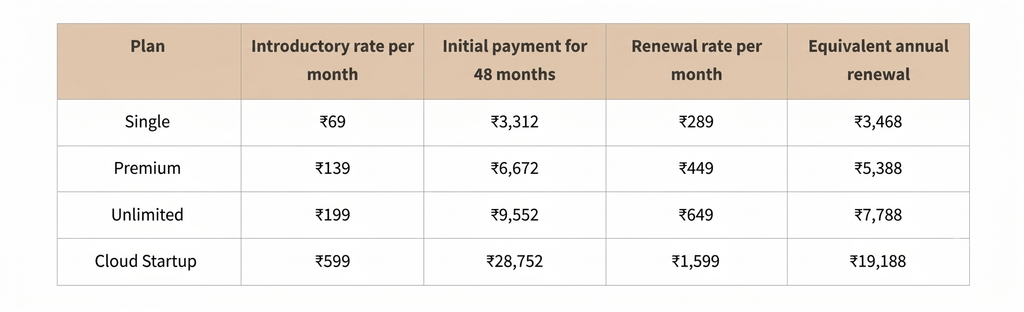
Source: Hostinger India official pricing page.
Prices reflect the listed 48-month offers and renewal rates at the time of checking. Confirm the current rates, plan eligibility, taxes, and checkout total before purchasing. The table does not include domain renewals or optional add-ons.
What does the renewal increase look like?
Comparing the listed monthly equivalents shows how much the renewal rate differs from the introductory rate.
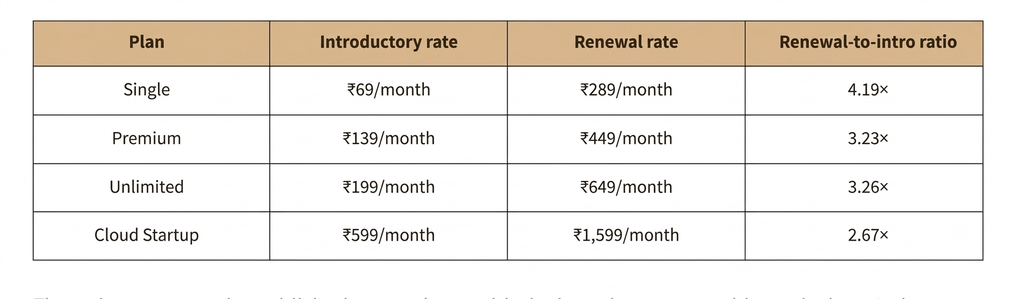
The ratio compares the published renewal rate with the introductory monthly equivalent. It does not mean the provider charges the renewal rate during the initial subscription.
For example, the Single plan’s introductory monthly equivalent is ₹69, while its listed renewal rate is ₹289 per month. The Premium plan’s equivalent rates are ₹139 and ₹449 per month.
These differences demonstrate why the renewal price matters when evaluating a hosting offer. A low initial rate may be attractive, but you should also consider the length of the promotional term and the future cost of keeping the website online.
4. How Billing Periods Affect Web Hosting Prices
Hosting providers may offer monthly, annual, biennial, and multi-year subscriptions, depending on the plan. Longer subscriptions can reduce the advertised monthly equivalent, but they require a larger upfront payment.
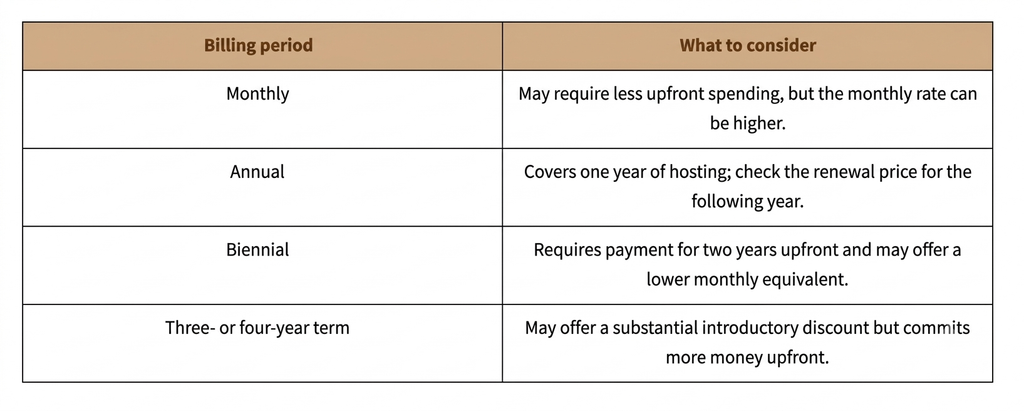
Consider how long you expect to use the service before choosing a billing period. A longer term may suit an established website with predictable needs, while a shorter subscription may make more sense if you are testing a new project.
Always distinguish between a monthly payment and a monthly equivalent. A plan advertised at ₹139 per month for 48 months costs ₹6,672 upfront before applicable taxes and other charges.
5. GST, Domain Renewal, Backups, and Other Hosting Costs
The subscription price is only one part of your website’s hosting budget. Additional charges depend on the provider, plan, and services you select.
GST and applicable taxes
Check whether the advertised price includes GST or whether tax is added at checkout. If 18% GST applies to a hosting charge of ₹2,400, the calculation is:
- Hosting charge: ₹2,400
- Illustrative GST at 18%: ₹432
- Total: ₹2,832
This is an example of the calculation, not a guarantee that every provider displays prices on the same tax basis. Check your provider’s checkout and invoice for the applicable tax treatment.
Businesses registered for GST may be eligible to claim input tax credit when the relevant legal requirements are met. Eligibility depends on the transaction and applicable tax rules.
Domain registration and renewal
Some plans include free domain registration for a limited time, based on plan eligibility. You may then have to pay for the domain each year separately.
Do check before buying:
- If a domain is included with your chosen plan.
- Which domain extensions are eligible for the offer
- The intro domain benefit is for how long.
- The cost to renew the extension you chose.
- If domain privacy or other services are additional.
Separate your domain renewal budget from your hosting renewal budget. The renewal invoice may be higher for both services.
Website backups
Backups enable you to restore your website’s files and databases in the event of accidental deletion, failed updates or other problems. Backup frequency, retention periods, restoration options and storage included are different for each hosting plan.
Check whether your plan includes automatic backups, and if restoring a backup is a chargeable extra, before you buy. Also check to see if backups are daily, weekly or on-demand only.
Include the cost of backups in your comparison if they are sold separately. Not every provider offers the same backup service or charges the same amount.
SSL certificates and security
Most hosting plans come with free SSL certificates. Before you buy a separate certificate check if SSL is included.
Depending on the provider and plan, you may pay extra for advanced malware protection, security monitoring or other security services. Rather than paying for something you already have, consider the security features that come with it.
Email, migration, and optional extras
Other possible expenses include professional email accounts, additional storage, website migration, dedicated IP addresses, CDN services and premium support.
These services are not always needed for every website. Check out the features that are included in your plan and only purchase add-ons when your needs justify the expense.
6. How to Find Out the True Cost of Hosting
To make a fair comparison of hosting plans, determine the total cost for the period you intend to use the service.
Total hosting cost = Initial subscription payment + Renewal payments + Domain charges + Required add-ons + Applicable taxes
For multi-year subscriptions, use the actual amount payable for each term rather than multiplying the advertised monthly equivalent by 12 and assuming that is your total bill.
Example: A two-year hosting budget
The following example uses hypothetical prices to show how different costs add up. These are not quoted prices from a hosting provider.
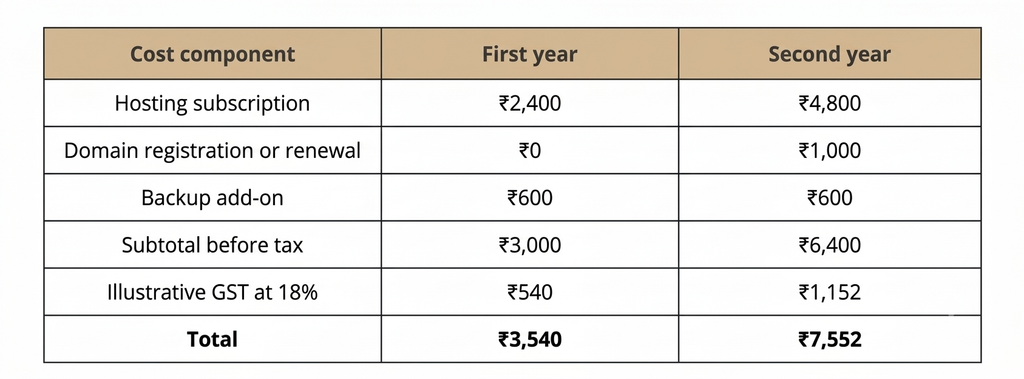
Under these assumptions, the total cost over two years is ₹11,092, including the illustrative tax.
The example assumes that the domain is included in the first year, hosting and backup charges are taxable, and the same illustrative tax rate applies in both years. Actual costs will depend on your provider’s prices, billing terms, included features, and applicable taxes.
For a real comparison, obtain the initial checkout total and the applicable renewal rates, then add any domain renewals and services you genuinely need.
7. How to Choose Cheap Web Hosting in India Without Overspending
Cheap web hosting can be a sensible option if the plan provides the resources and features your website needs. The objective is to find a plan with an affordable initial payment and a renewal cost you can budget for.
Use this checklist before purchasing:
- Compare the renewal price. Check the published renewal rate for the exact plan you intend to purchase.
- Calculate the upfront payment. Confirm the full amount payable for the selected billing period.
- Review included features. Check storage, SSL, email accounts, backups, and migration options.
- Account for domain renewal. Include the future domain cost if registration is only included for an introductory period.
- Check taxes. Confirm whether the displayed price includes GST.
- Avoid unnecessary extras. Review optional services at checkout and remove those you do not need.
- Choose a suitable plan. Match the plan to your website’s traffic, storage requirements, and technical needs.
Do not choose a plan based solely on its lowest advertised rate. A longer subscription may offer a lower monthly equivalent but require more money upfront, while a shorter term may have a higher effective price.
For practical guidance on matching hosting resources and features to your website’s needs, read how to choose a web hosting plan for your website.
8. Compare Shared Hosting Plans
For a new blog, portfolio, or small business website, shared hosting can be a practical starting point. It allows multiple websites to use resources on the same server, which generally makes it more affordable than hosting arrangements that provide dedicated resources.
When comparing shared hosting plans, review the number of supported websites, storage capacity, email facilities, control panel, backup policy, security features, and renewal terms.
Explore Cyberin’s shared web hosting plans to review available plans, features, and current pricing. Check the applicable billing period, introductory offer, and renewal terms before placing your order.
Conclusion
Web hosting prices in India can look inexpensive at first, but the real cost depends on more than the introductory monthly rate. Billing periods, renewal prices, domain registration, taxes, backups, and optional services all affect how much you spend.
Before choosing a plan, compare the total upfront payment with the renewal cost and calculate the expected expense over your intended hosting period. This makes it easier to evaluate cheap web hosting options and choose a plan that fits your website requirements and budget.
Frequently Asked Questions
Why is web hosting cheaper in the first year than at renewal?
Many hosting providers offer introductory discounts for the initial subscription term. When that term expires, the plan renews at the applicable renewal rate. Check the promotional duration and renewal price before purchasing.
What is the web hosting renewal price?
The renewal price is the amount charged to continue using a hosting service after the current subscription expires. It may differ from the introductory rate, so check the price for the exact plan and renewal period.
Is GST included in web hosting prices in India?
GST treatment varies by provider and offer. Check the checkout page and invoice to determine whether tax is included in the displayed price or added separately.
Do hosting plans include a free domain?
Some hosting plans include domain registration for an introductory period, subject to the provider’s terms. Domain renewal may be charged separately, so verify the eligible domain extensions and renewal price.
Are website backups included in web hosting plans?
Backup features vary by plan. Some providers include automatic backups, while others limit backup frequency or charge for additional services. Check backup frequency, retention, and restoration terms before purchasing.
How can I compare web hosting prices fairly?
Compare the full upfront payment, subscription duration, renewal rate, applicable taxes, domain charges, and required add-ons. Use the same comparison period for each plan so that you can estimate the overall cost more accurately.
Is cheap shared hosting suitable for a new website?
Shared hosting is generally suitable for many new blogs, portfolios, and small business websites. Choose a plan based on your expected traffic, storage requirements, included features, and budget.
